Monday, July 13, 2009

Let the Mid-Term Elections Begin.... NOW!


So Cheney is in the news again. More trouble with secrecy, yadda yadda. I frankly don't find this too surprising. Here's my take on what's happening:

I suspect the Democrats wanted to roll this little gem out to the public a little later. Say... this time next year just as the mid-term elections are heating up. But it came out now. What gives?

I see a couple of possibilities:

#1 Democrats know more and want an investigation now to dig up more embarrassing stuff this time next year. So... Democrats leaked to NYT (?)

#2 Republicans know even more than the Democrats and want this trash aired now to clear the air for next year. So... Republicans leaked to NYT (?)

#3 Republicans know so much that they're working behind the curtains to get Democrats to trip up because of an investigation they really want. In this scenario, Republicans would LOVE an investigation that focuses for the next year or more on how much Republicans worked to secure our country and it would simultaneously dig up ways that Democrats were sabotaging these security measures.... Democrats foolishly leaked to NYT (?)

We'll see. It'll be interesting to see the way this story turns. But one thing's for sure: just whisper Cheney and there will be a Democrat eager to talk your ear off about it.

I do have one nagging question about this episode, though: Does Cheney actually have executive authority? I had presumed before that the whole point of VP's was that they didn't have actual executive authority until something happened to the president?

Thursday, April 30, 2009

Bernie! You're a Genius!

I have an idea for an SNL skit about Ponzie schemer Bernie Madoff. This one was pretty lame:


Mine is way better. Here it is:

Roll the clock back, before people knew about the Ponzie scheme. Bernie hosts poker night with some of his friends/clients. After every hand, everybody wins more money than they put in, and Fred Armisson keeps saying, "Bernie! You're a genius! How do you do that?" and everybody keeps putting more money in. Eventually, they start betting money from their foundations, trusts, etc. On the last hand, Bernie wins everything and everyone's pissed.

Friday, January 2, 2009

NASA + DoD: Getting Us To The Moon Together?

When we think of "space programs", most of us think of NASA, the space shuttle, the space station, maybe the Mars rovers... It is less known that most of our nation's space budget is spent by the DoD.

Now news is swirling that Obama will try to get NASA to:

1) Scrap its Ares program rockets

2) Replace them with rockets already being used by DoD

(Here's one such article from Bloomberg.)

The news is about cost savings or cost sharing. I am starting to believe that the Obama years will be punctuated by pragmatism. I believe this is why he is keeping Bob Gates as his Secretary of Defense. I think this is a great move. He gets things done. Aviation Week just named him their "Person of the Year" largely for that reason.

NASA chief Michael Griffin does not have that same pragmatic reputation. He's been implicated in trying to snuff out the opinions of his own scientists regarding global warming. He's also dishonest. In 2005 he had announced that he would not reduce NASA's science budget, but in 2006 slashed it by 25% to pay for manned space programs. Griffin wants us to inhabit the solar system, have nuclear-powered spaceships, et cetera et cetera.

The point is, he has a vision too much his own. Gates thus far seems to be the consumate bureaucrat in the best sense. He executes his boss' vision to the best degree possible. For these reasons and more, I think that the biggest benefit of such a realignment would be to perform an end-run around Griffin and focus on results. If Gates becomes involved in oversight of our moon missions, I think we might just get there. Under Griffin, I suspect we would see schedule slips and cost overruns and, honestly, might still not get there before a future president cans the whole thing.

So I'm cheering for this.

Wednesday, December 31, 2008

Shuttle Missions are Dangerous Enough Without Management's Help

Another report on the Columbia accident was released yesterday. This one was authored and researched by astronauts, some of them close friends of fellow astronauts who died on Columbia.

What struck me of the report are the echos of Challenger. It's painful. From a New York Times article about the report:

The impact of the foam was obvious in videos taken at launching, and during the Columbia’s 16-day mission, NASA engineers pleaded with mission managers to examine the wing to see if the blow had caused serious damage. The managers, however, held firm to the then-common belief that foam strikes were relatively harmless and constituted a maintenance problem, not a fatal risk.

In a scathing report issued in August 2003, an investigative board later found that a “broken safety culture” at the National Aeronautics and Space Administration was largely responsible for the deaths. It criticized managers as complacent and too tightly focused on scheduling and budgetary pressures.

This means that little changed since the 1986 Challenger disaster when o-rings made by Thiokol failed, causing the Challenger to blow up. The o-rings failed because the Challenger had launched in freezing temperatures, and the o-rings were only rated to 40°F. From a Wikipedia writeup about the accident:

...At a teleconference which took place on the evening of January 27, Thiokol engineers and managers discussed the weather conditions with NASA managers from Kennedy Space Center and Marshall Space Flight Center. Several engineers—most notably Roger Boisjoly, who had voiced similar concerns previously—expressed their concern about the effect of the temperature on the resilience of the rubber O-rings that sealed the joints of the SRBs. Each SRB was constructed of six sections joined in three factory joints and three "field joints".

...Despite public perceptions that NASA always maintained a "fail-safe" approach, Thiokol management was influenced by demands from NASA managers that they show it was not safe to launch rather than prove conditions
were safe. It later emerged in the aftermath of the accident that NASA managers frequently evaded safety regulations in order to maintain the launch manifest (schedule).

That NASA management, almost 20 years after the Challenger accident, had not learned to listened to their engineers is despicable. But I think a deeper problem sits below. For reasons I don't understand, NASA promotes an image of its manned space programs "fail-safe". Oh sure, everybody "knows that they are dangerous"... But on the Challenger they were sending a teacher, Christa McAuliffe, into space! (Factoid: my elementary school was named after her.)

NASA should change two things, then:

1) It needs to make missions actually safer by listening to its own engineers, and those of its contractors.

2) It should stop promoting their "fail-safe" image and instead emphasize that astronauts are really heroes on dangerous missions operating under immense personal risk.

Flying on the shuttle is dangerous enough. Both shuttle disasters were avoidable (especially Challenger). Maybe NASA managers have been drinking too much of their own "fail-safe" kool-aid, believing their systems to be so robust they would withstand their bad decisions. Maybe by embracing the fact that these missions are so dangerous, the managers would actually get a clue and understand how much trust is being placed in their hands. Maybe, just maybe, they would take their responsibilities to the astronauts more seriously.

Monday, December 29, 2008

Congratulations SpaceX, Orbital Sciences Corp, and NASA

NASA has awarded contracts to SpaceX and Orbital Sciences Corp. contracts to deliver cargo to the International Space Station for the next dozen or so years. This is news, big news, huge news, for the geek that I am. From a Wall Street Journal article:

"When the U.S. space shuttle fleet is retired sometime after 2010, such so-called Commercial Orbital Transportation Services contracts temporarily will be the only way for U.S. spacecraft to reach the space station."

This is a huge risk. These companies do not have the traditional experience of building such systems for the government. But the news is even bigger than this.

The procurement will be via the NASA "Commercial Orbital Transportation Services" contract type. So what's the big news about this? It goes like this:

If the government wants to buy, lets say, a military base, it can't just buy one. It puts a team of government employees together to put together ideas for what the base should be like and then look for contractors willing to do it for a good price. This is how our government pretty much gets rockets today. It doesn't buy "rockets", it buys "rocket programs". (As an alternative metaphor, imagine if you couldn't buy clothes for yourself, but instead had to keep creating clothes patterns for what you wanted and shop the designs out to tailors for a good price. That would be an annoying world!)

If the government wants to buy an SUV, it just friggin' buys it. It doesn't need to assemble a team to put together ideas for what an SUV should be like! Sure, there might be some mods but for the most part the government gets in line with the rest of us and buys a friggin' SUV!

THIS is the real news. SpaceX and Orbital want to sell rockets commercially, more or less the way auto companies sell cars. So if our government wants a rocket, it should get in line with telecom companies and other governments and buy the next rocket slot.

This is a big gamble. NASA will take a sort-of hybrid approach, trying to be as hands-off as possible while still assuring success. It will check in on these companies at critical junctures and try to stay out in between. If it works, it would point the way to a new way to procure rockets, though. No more managing the contractors, no more having to create requirements for rockets, no more eating the inevitable cost overruns and the schedule slips. Just buy the next rocket.

If either SpaceX or Orbital succeed, then the entire experiment succeeds because it proves the concept. Even better, there are added dividends for our nation:

0) It proves that space companies can exist as truly private entities pursuing commercial interests. Contrast that to the current base of government contract-driven mega corporations.

1) Commercial companies should spur rocket innovation faster than Lockheed or Boeing or Northrop (or Energia or Arianspace, for the internationally minded) because they can try stuff out without waiting for government permission or government requests.

2) Commercial companies should reduce the overall cost of these systems to the point where more rocket launches should be possible, which should create more higher-paying jobs that are supported by the private industry.

3) By being a commercial company, SpaceX and Orbital will reduce the price not only for satellite operators and governments, but also for our fledgling Space Tourism industry.

All of this is great. Outstanding.

Lastly: I just really want to applaud Elon Musk for having the courage to gamble so much of his private fortune from his PayPal sale to create SpaceX. His achievement cannot be overstated: to privately develop a rocket from scratch. It hurts me a little to say this since I work at one of the government contract-driven megacorporations, but I think that his Silicon Valley shtick is going to rock our Aerospace world.

Wednesday, November 19, 2008

Bailout out America, not just GM

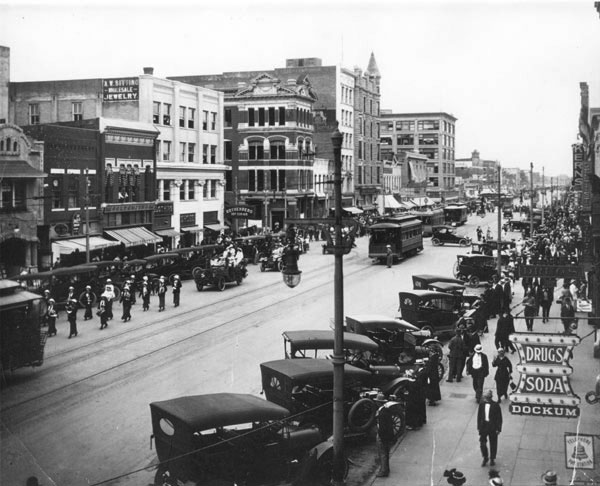
As a person interested in urban planning and development issues, I had learned some time ago of General Motors' efforts to deliberately buy municipal street car systems and demolish them. The intent, obviously, was to promote the car.

Few now are aware, but nearly every American city had electric street cars before World War II. Los Angeles even, now famous for crisscrossing ribbons of freeways, was loaded with street cars. This L.A. Times blog includes pictures of L.A. streetcars circa 1911. Check these out:


...or


Washington, DC is right now trying to bring street cars back to Anacostia and possibly the Purple Line through some of DC's suburbs. But here's a look back at what DC used to be like (complements of Wikipedia's Streetcars in Washington article):

Pennsylvania Ave, facing our Capitol


15th St NW (next to the Dept. of the Treasury)

Don't think that the Streetcars were limited to areas outside of "Real America" either. Here's Minneapolis in 1906:


And here's Wichita, Kansas (compliments of the Wichita Photo Archives, which has lots of interesting such photos):


So what happened to all of these streetcars? What happened to their tracks? The tracks were covered over and the streetcars were destroyed save a few for museums and the like. In some places the tracks weren't even completely covered, like in the stretch of Georgetown on the picture on the right.

And GM wants a bailout...

I say give it to them. Give them a really good bailout. But for the bailout, make them build our streetcars back. I don't say this for "revenge" or social justice, not for the environment or for a chance to legislate better cities. I say it for economics.

If we give GM a bailout on their terms, they will still go to bankruptcy, just a few years later. They can't compete on cars. They made critical mistakes in the last decades: they dropped the ball on quality, they dropped the ball on fuel economy, and they dropped the ball on manufacturing effeciency. GM does not have a credible plan for using our tax dollars to get back in the game and become self-sufficient. When Chrysler got a government bailout in the 80's, they had a plan: the minivan. That worked. Right now, there is no credible plan.

So I say we stick one on them. Use American labor to build streetcars for cities and towns across our nation. Tie our cities together again with high-speed passenger rail with trains built by American labor. Let Hyundai, Honda, Toyota, Nissan, VW, BMW, and Mercedes expand their American presence. Let them employ Americans from Kentucky to Texas, Virginia to California (Detroit is left out on purpose: it shunned foreign car companies-- another critical mistake for Detroit.) Let them go wild building better cars for us. Let our companies earn their bread and butter on American trucks and trains.

If we allow GM to get a handout to keep building cars the way they have, then we are neglecting our fellow citizens at GM who are hard-working but happen to work for a company without a plan. Lets give them one. And while we're at it, lets improve life for tens of millions of Americans by giving them a real alternative to paying more for gas.

Lets not bailout just the fat cats at the failing banks or the complicit auto-CEOs and union leaders who will drive our companies off a cliff. Lets build our rails with American steel, design our trains with American engineering, create our stations with American architecture. Lets employ tens of thousands of Americans to operate and maintain these systems. Lets breathe new life into old towns. Lets bailout America, not just GM.

Saturday, November 15, 2008

EZ-Pass of the Future: SpeedyPass

Across our nation, state and municipal budgets are drying up. Colorado transportation budget is getting slashed thirty percent.

In my area, local newsletters are filling with complaints that police must be on funding drive because they are stepping up speed limit enforcement to a previously-unheard-of level. (Bully the complainers: I'll happily pay my once-every-three-years speeding ticket for all of my time saved: that's just economics for me.)

But maybe there's a real opportunity here. For those not in the know, E-ZPass is a must-have in the DC, NY, Boston corridor, and it goes all the way to Chicago. You get a thingy-bob that pays tolls for you while you're rolling 35 to 55 mph and it recharges itself from your credit card. It's great.

So here's what I propose:

Offer a new system, I'll call it SpeedyPass, that can track you on the highway, and offer 2 lanes of traffic for SpeedyPass holders only. Then, make the speed limits digital to reflect how fast traffic can go (faster on nice days, slower on crappy days or at night) and automatically levy lots of really small speeding fines every five minutes or so and run up a tab for you. If you're really going so fast that you are a public menace, then "the man" can come and get you. Voila! More revenue, and the cop didn't even have to pull anyone over except people are actually putting others in danger.

Little factoids I just recently learned: When speed limits were first created, they were calculated by engineers as the highest speed for which 85% of travelers would remain safe. In other words, they weren't "limits" the way we think of them today, but actually reflected how fast you could safely go in good weather. The other factoid I've known for a while: during the oil crisis in the 70's, our government told all states to set their speed limits no higher than 55mph or the feds would withhold highway money. That went away some years ago, but a lot of speed limits are still set to 55mph on huge freeways. Why?!?!? Cars are safer now and are more fuel effecient now. Shouldn't speed limits reflect this?

So SpeedyPass. That's the un-ticket :-D

Images from:
Creative Commons: http://farm1.static.flickr.com/25/94411850_2ac5e973d8_m_d.jpg
EZ Pass website: http://www.e-zpassiag.com/IAG-E-ZPASS-MAP%20New.jpg