Wednesday, November 19, 2008

Bailout out America, not just GM

As a person interested in urban planning and development issues, I had learned some time ago of General Motors' efforts to deliberately buy municipal street car systems and demolish them. The intent, obviously, was to promote the car.

Few now are aware, but nearly every American city had electric street cars before World War II. Los Angeles even, now famous for crisscrossing ribbons of freeways, was loaded with street cars. This L.A. Times blog includes pictures of L.A. streetcars circa 1911. Check these out:


...or


Washington, DC is right now trying to bring street cars back to Anacostia and possibly the Purple Line through some of DC's suburbs. But here's a look back at what DC used to be like (complements of Wikipedia's Streetcars in Washington article):

Pennsylvania Ave, facing our Capitol


15th St NW (next to the Dept. of the Treasury)

Don't think that the Streetcars were limited to areas outside of "Real America" either. Here's Minneapolis in 1906:


And here's Wichita, Kansas (compliments of the Wichita Photo Archives, which has lots of interesting such photos):
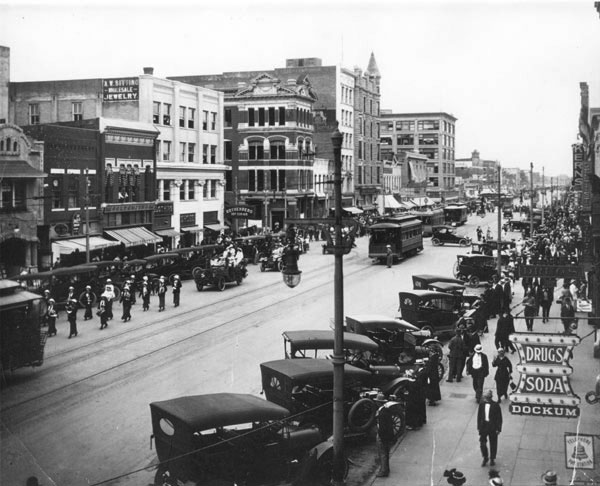

So what happened to all of these streetcars? What happened to their tracks? The tracks were covered over and the streetcars were destroyed save a few for museums and the like. In some places the tracks weren't even completely covered, like in the stretch of Georgetown on the picture on the right.

And GM wants a bailout...

I say give it to them. Give them a really good bailout. But for the bailout, make them build our streetcars back. I don't say this for "revenge" or social justice, not for the environment or for a chance to legislate better cities. I say it for economics.

If we give GM a bailout on their terms, they will still go to bankruptcy, just a few years later. They can't compete on cars. They made critical mistakes in the last decades: they dropped the ball on quality, they dropped the ball on fuel economy, and they dropped the ball on manufacturing effeciency. GM does not have a credible plan for using our tax dollars to get back in the game and become self-sufficient. When Chrysler got a government bailout in the 80's, they had a plan: the minivan. That worked. Right now, there is no credible plan.

So I say we stick one on them. Use American labor to build streetcars for cities and towns across our nation. Tie our cities together again with high-speed passenger rail with trains built by American labor. Let Hyundai, Honda, Toyota, Nissan, VW, BMW, and Mercedes expand their American presence. Let them employ Americans from Kentucky to Texas, Virginia to California (Detroit is left out on purpose: it shunned foreign car companies-- another critical mistake for Detroit.) Let them go wild building better cars for us. Let our companies earn their bread and butter on American trucks and trains.

If we allow GM to get a handout to keep building cars the way they have, then we are neglecting our fellow citizens at GM who are hard-working but happen to work for a company without a plan. Lets give them one. And while we're at it, lets improve life for tens of millions of Americans by giving them a real alternative to paying more for gas.

Lets not bailout just the fat cats at the failing banks or the complicit auto-CEOs and union leaders who will drive our companies off a cliff. Lets build our rails with American steel, design our trains with American engineering, create our stations with American architecture. Lets employ tens of thousands of Americans to operate and maintain these systems. Lets breathe new life into old towns. Lets bailout America, not just GM.

Saturday, November 15, 2008

EZ-Pass of the Future: SpeedyPass

Across our nation, state and municipal budgets are drying up. Colorado transportation budget is getting slashed thirty percent.

In my area, local newsletters are filling with complaints that police must be on funding drive because they are stepping up speed limit enforcement to a previously-unheard-of level. (Bully the complainers: I'll happily pay my once-every-three-years speeding ticket for all of my time saved: that's just economics for me.)

But maybe there's a real opportunity here. For those not in the know, E-ZPass is a must-have in the DC, NY, Boston corridor, and it goes all the way to Chicago. You get a thingy-bob that pays tolls for you while you're rolling 35 to 55 mph and it recharges itself from your credit card. It's great.

So here's what I propose:

Offer a new system, I'll call it SpeedyPass, that can track you on the highway, and offer 2 lanes of traffic for SpeedyPass holders only. Then, make the speed limits digital to reflect how fast traffic can go (faster on nice days, slower on crappy days or at night) and automatically levy lots of really small speeding fines every five minutes or so and run up a tab for you. If you're really going so fast that you are a public menace, then "the man" can come and get you. Voila! More revenue, and the cop didn't even have to pull anyone over except people are actually putting others in danger.

Little factoids I just recently learned: When speed limits were first created, they were calculated by engineers as the highest speed for which 85% of travelers would remain safe. In other words, they weren't "limits" the way we think of them today, but actually reflected how fast you could safely go in good weather. The other factoid I've known for a while: during the oil crisis in the 70's, our government told all states to set their speed limits no higher than 55mph or the feds would withhold highway money. That went away some years ago, but a lot of speed limits are still set to 55mph on huge freeways. Why?!?!? Cars are safer now and are more fuel effecient now. Shouldn't speed limits reflect this?

So SpeedyPass. That's the un-ticket :-D

Images from:
Creative Commons: http://farm1.static.flickr.com/25/94411850_2ac5e973d8_m_d.jpg
EZ Pass website: http://www.e-zpassiag.com/IAG-E-ZPASS-MAP%20New.jpg

Friday, November 7, 2008

(Not) In the Interest of Shareholders

Law states that corporate executives must act at all times in the interest of their shareholders. Implicit within the law is that shareholders can only have one interest: more $$$. I offer two examples of where that implicit assumption falls apart:

1) Employee-Owners: I have a 401k and my company gives a 50% match in company stock, so I and other employees are shareholders. I do like it when the share price goes up. But beyond a certain price gain, I have other priorities. For instance, I would always like better health care: more coverage, lower co-pays, no networks, etc etc. I also wouldn't mind the company investing money on speculative, long-term R&D. Lastly, I'd like my company to set aside cash to weather the rough patches better and ensure longevity. These actions would suppress profits and therefore share price or dividend yields--but I'm a shareholder too! And this is in my interest!

2) Socially-Conscious Investing: I would fully support profit-reducing initiatives at my company and every company I own stock in to reduce CO2 footprints even when the business case for it is not clear. As an example, a business could buy carbon offsets for their business travel. The CEOs might even want to at a personally level, but they can't without that business case. Doing right for the public is not enough, even if the shareholders "say so".

I'm sure there are more examples. What irks me about this setup is that the concept of ownership interest is reduced to share price. What if the citizens of a city, in order to take back their rivers or communities, banded together to buy a controlling stake in the corporation with that factory up-river? Is the CEO of that corporation, against the will of the shareholders, required to continue maximizing share price even at the expense of that river? That should be changed. I believe that a business does not have to lose its moral sense when it incorporates, yet the law clearly states that it pretty much has to. The only check on this is government regulation that creates a compelling business case (by incorporating likely fines or loss of licenses) to not take the cheapest route at every turn.

So I say it's high time to review this law.

(Update) Consider this:


(link)

Thursday, November 6, 2008

Some Insights into Future Defense Spending?

Military.com reprinted an article from the NYT and re-titled it: Wall Street Pain Coming to Military. (That actually sounds better but less accurate than the NYT’s original title: Pentagon Expects Cuts in Military Spending.)

On the other hand, Aviation Week runs with: Obama to Support Defense, Space Technology.

In either case, some excerpts from the NYT article:
  • The obvious targets for savings would be expensive new arms programs, which have racked up cost overruns of at least $300 billion for the top 75 weapons systems, according to the Government Accountability Office….
  • In all, the Defense Department now accounts for half of the government’s total discretionary spending…
  • On the presidential campaign trail, Senators John McCain and Barack Obama have pledged to cut fat without carving into the muscle of national security…
  • “I think we need a complete review of this whole thing,” said Representative Neil Abercrombie, a Democrat from Hawaii who is chairman of a House Armed Services subcommittee. “You cannot make a case for undermining the readiness of the Army and the Marines in the circumstances that we face today with a commitment of so much money to weapons systems that are at best abstract and theoretical.”…
  • Boeing’s chief executive, W. James McNerney Jr., recently wrote in a note to his employees: “No one really yet knows when or to what extent defense spending could be affected. But it’s unrealistic to think there won’t be some measure of impact.”…
  • Other analysts, like Loren B. Thompson of the Lexington Institute, a policy research center, say that weapons spending will be fiercely defended by many in Congress and their allies in the weapons industry as a way to stimulate the economy.
I guess the Pentagon doesn’t read Aviation Week. They’re saying:
  • Obama's campaign says he advocates unmanned aircraft, electronic warfare capabilities and cyber security among several other national security efforts. The tech emphasis aligns with Obama's promises to buttress the military's personnel ranks while wrangling control of the DOD's problem-plagued acquisition portfolio…
  • Obama during the late summer appeared to shift his support toward the Bush Exploration Vision goal of returning astronauts to the moon by 2020, noting that he "endorses the goal" of a lunar return "as a precursor in an orderly progression to missions to more distant destinations, including Mars."…
  • Nevertheless, while the Democrats assert their willingness to develop, buy and equip the U.S. military with the best weapons and technology, the platform of Obama and Vice President-elect Sen. Joseph Biden (D-Del.) still paints a person-over-program picture.
So where does this all lead? I don’t know, but we’ll get a lot of insight when the future Secretary of Defense is announced.

Wednesday, November 5, 2008

Conservatives Will Support Obama. Here's Why.

For the last 8 years, I heard that to support the troops I must support the war. I have never agreed more strongly with this view, because it also translates to: it is impossible to support America without supporting the president. Presto! Conservatives support President Obama.

For the record, my position is so nuanced Kerry might get lost in it. There cannot be a position on "the war". We are in TWO wars. I support the war in Afghanistan. I cannot support the war in Iraq. I wanted to. I wanted the war to be about democracy and liberty, about helping people. I wanted it to be about the same reason that we go into Somalia or should act on Darfur. But it was turned into a war about non-existent WMD, a war of choice not based in compassion, a war executed on the cheap. Our troops deserved a better Commander-in-Chief and Secretary of Defense, one who would commit an overwhelming force for the take-down and for the occupation, one who would ask for more from us than to support tax cuts. Our troops put their lives on the line. I would have proudly forgone my tax break but to do better for our troops.

Years late, we committed more troops under General Petraeus and we finally got a SecDef worthy of the troops. I know it's impossible, but I do wish that SecDef Bob Gates could keep his job in an Obama administration.

So for any patriotic American conservatives reading: If you love America, then you support President Obama. If you do not, then welcome to nuance.

Monday, July 14, 2008

What's worse than rising oil prices?

I decided to write this post after seeing this article today on Aviation Week and it reminded me of a joke that someone once shared with me:

Q. What's worse than finding a worm in your apple?
A. Half of a worm.

This is kind of where we are with oil prices. We have a worm, but that's better than half of a worm. Some are calling to put an end to the speculative side of the oil trade. There's some merit in this, except for this basic problem.

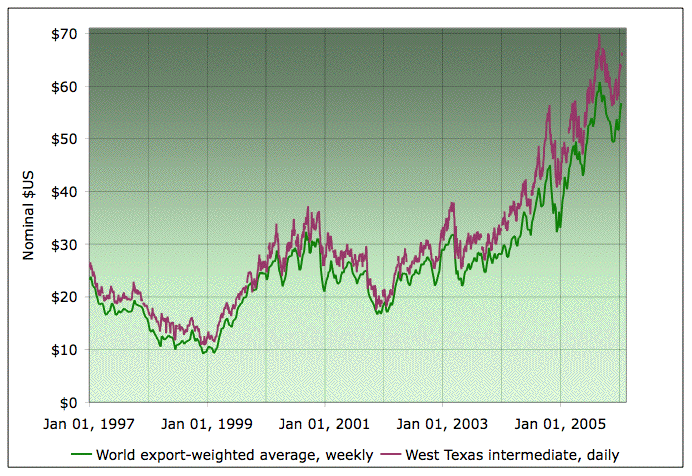
Oil prices are currently running up to a "what the market will bear" regimen. A price any lower than that point necessitates a subsidy (or extortion) from someone. That someone has traditionally been (drum roll please) OPEC itself. We used to rail against OPEC fixing oil prices. Well, they used to (click here for some of OPEC's faq), and they don't anymore. And prices have done the following:

So OPEC used to be the bogeyman, and it can't be blamed anymore. Most of the member states have been pumping flat-out for some time now. Here are some listings of articles from the last couple of years:

(2008) article from XE.com
(2008) article from TradeArabia.com
(2004) EnergyBulletin.net posting

The OPEC member states say they are trying to bring down prices by increasing supply, but one cannot help but think that they must be at least a little happy at the extra cash. Anyone seen pictures of Dubai recently? Here's a nice little post on a little construction there, but I can't help but sneak at least one picture of Dubai right here:

...and here's a 71-minute Google Video on Dubai's plans for itself:


So we know: 1) OPEC says it's pumping flat-out, and 2) it serves OPEC's states' interest to pump flat out (to buy all those awesome towers).

So why would oil prices be where they are?

This is asking exactly the wrong question. The question is: why haven't they been higher for longer? Here's my answer:

The prices have been held down for much of this time. Prices have not reflected "what the market will bear" for a while now. If oil prices had stayed this high for this long during the 1980s, oil despots would be facing international pressure, then sanctions, then maybe some covert meddling, and maybe even outright war. It would have been easy in the 1980s to dig up one reason or another to legitimize war, whether it would have been a Cold War proxy war or to "help" the citizens of that country overcome a tyrannical leader. I'm not suggesting that I oppose helping citizens overcome tyrannical leaders; but I am suggesting that too many nations "deserve" that meddling and other factors ultimately must be used to decide which countries will be so lucky. Oil is a fine reason.

Simultaneously, we decided to create new ways to trade "oil". I say "oil" in quotes because we have been trading oil for a long time. The new trading was in derivatives for oil futures contracts. Here's someone who's pretty upset about this recent advent, but this person still has it wrong. The bottom line is that, with gas higher than $4 per gallon, we are still buying gas. Less of it? Sure, in our country. But worldwide, demand continues to grow. So just think about this: the price of oil went up, and the quantity that we want (as a world) goes.... up. What other outcome could possibly come about except that prices go higher!

So while some people are fuming at the "oil speculators", I say they are just people who are profiting on what many of us refuse to accept: that the market will bear much higher oil prices. I agree that they are speeding our arrival at a higher price, but I simply posit that oil prices were not suppose to be lower in the first place. Our government could intimidate oil exporters, but it cannot intimidate the electronic herd of financial traders. This is market economics, like it or not.

Do I think that rising oil prices is good? No. But I think we'll pull through it, and frankly I think we'll be better at the end of it. In the meantime, there's a lot of hurt through this change, and unfortunately it will catch exactly the people who are not in a position to deal with the increased prices in its cross hairs. But with all of that said, I think it's high time that we take a deep breath, accept that oil prices are high, and change some of our habits accordingly.

So now I can rewrite that apple-and-the-worm joke:

Q. What's worse than rising oil prices?
A. Always having had high oil prices.

Thursday, July 10, 2008

Lets Privatize Fire Departments ;-)

It's an election year, so Health Care is in the air again. I don't know what the answer is, but there is no denying that there is a problem. My biggest beef with the market-based advocates is their "anything else would be socialist medicine" hypocrisy. The problem is, there are common examples where this argument falls apart. In conversation, everyone I have talked to who is rabbidly "anti socialized medicine" has scoffed at the following suggestion:

1) Announce that in five years all publicly-funded fire departments will be privatized.
2) Everyone will be eligible to purchase fire response insurance. Most people will get it through their employers.
3) Fire insurance can be administered (and denied, before and/or after "treatment") just like medical insurance.

So imagine that world!

You get home and see smoke coming out of a window, and you get your fire rescue insurance card out. You start calling fire departments and verifying that they take your insurance. A firehouse that says it does accept your insurance responds to the fire with a single of its smallest trucks, but you live on the 10th floor of a condo tower! You're pissed! You told them over the phone that you live on the 10th floor!

The fireman says he understands your frustration, but the fire ladder is a specialist that requires a referral from the puny fire truck. That's okay though! The fireman sees the smoke too and agrees that the ladder should come. At least the ladder and the small truck work in the same group, so they're both covered by your insurance (whew!). So your abode is burning inside, but the ladder makes it on time to wet the ashes. The good news is that you only have to pay a co-pay and your deductible on the spot. The rest is covered by insurance.

Small problem: a post-investigation by the insurance company says that the ladder was never necessary. The fire was small enough so that the fireman should have climbed the stairs, entered the condo, it put it out from inside. So the insurance denies payment to the firehouse, and the firehouse needs payment from you.

That, to me, sounds like the kind of fire rescue system I would like to live under. And God help you if you lost your job (and fire rescue insurance) right before the house caught on fire! Yes sir! That sounds swell!

So it's election time again and Health Care is in the air, but lets have an honest dialogue about it, about what is best for the country, and cut the "socialist medicine" garbage out of the dialogue. I haven't met a person yet who would like the privatized fire rescue scheme.

I was reminded of the need to change our Health Care system again after watching this PBS Frontline special: Sick Around the World.

Thoughts?